Why (Do) We Fight
On Communicating the Object of a War

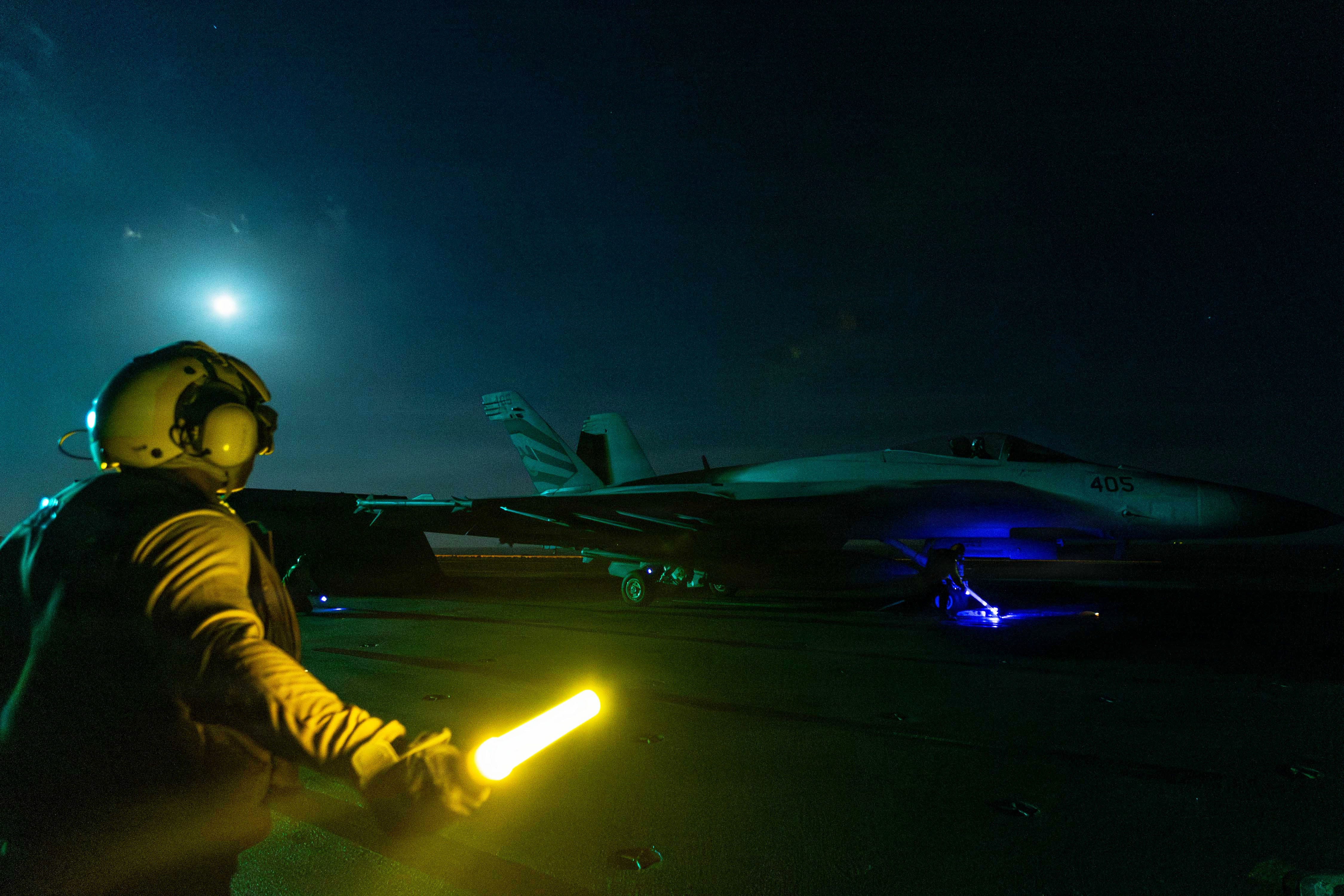
An F/A-18E Super Hornet prepares to launch from the USS Abraham Lincoln in support of Operation Epic Fury in the U.S. Central Command area of responsibility, March 3, 2026, US Navy
When you go to war, you need a why.
It is what Pericles was doing in his Funeral Oration when he praised the cause that the dead Athenians had been fighting for. It was what Lincoln had done at the Gettysburg Address. It was what Jefferson was doing when he wrote the Declaration of Independence.
It is what all good statesmen have done when leading a people to war.
The messaging from the current administration regarding Operation Epic Fury has been a bit confused in comparison.
Despite being a week into the war with Iran—it’s still entirely unclear what exactly we’re fighting to achieve. To give you an idea, I’d like to offer a sample of the various justifications and goals that have been floated in the past few days:
Look, I could keep going with this. It’s incoherent. We’re in a war that isn’t a war that’s a conflict we’ve won, and we’re also just starting; that isn’t regime change, but it is changing the Iranian regime.
There is—obviously—value in some ambiguity in messaging. You want to be able to keep your options open to be able to take off-ramps and de-escalate if needed. You want to be able to keep an adversary somewhat confused about the course of action you’re pursuing.
But there’s a difference between ambiguity and incoherence.
When you’re taking a nation to war, you need to explain to domestic and international audiences why you’re doing that.
Domestic populations deserve to know why they’re going to be subject to the costs of conflict—for instance, why the price of oil has climbed rapidly or why there are American casualties. You can’t just wave away rising prices and dead soldiers on a television.
If you don’t bother to make that case, or if your case is utterly incoherent, a domestic audience will rapidly sour on a war that they don’t feel is necessary, or even understand in the first place.
If a domestic audience feels a conflict is existential or necessary, they’ll be willing to bear those costs for a prolonged period of time—just look at the intolerable suffering Ukrainians have been willing to endure for years in service to a cause they believe is just.
If a domestic audience is ambivalent or hostile to a war effort? Congratulations, you’ve got Afghanistan circa 2014. It is even worse to somehow manage to start a war underwater with public approval.
Anyone with even a passing familiarity with Clausewitz—or just war in general—should be able to tell you that a war effort lives and dies by the willingness of a population to actually back that conflict.
You may be able to launch a conflict unilaterally1, but you cannot sustain any meaningful level of hostilities with a population unwilling to endure the costs of conflict.
The object of war, afterall, is a political object, and if nobody knows what that political object is, hardly anyone is going to be manning the barricades to see the matter through.
Moreso when there is inevitable hardship2 engendered by the use of violence.
Does a domestic audience understand the level of effort required to achieve a certain goal? Are they willing to endure those costs? Do they even care about the strategic goals you have in mind in the first place?
If you decline to even engage in the act of communicating—let alone actual public deliberations—you’ll never know the answer to those questions until you’re already in the thick of it.
It is the reason that during the Second World War, the United States Government produced propaganda videos like Why We Fight. It was necessary to explain to the American public why a global conflict mattered to them and why the costs were worth enduring.
When Americans inevitably lost sons and daughters overseas or queued in lines for sugar, they knew the why.
They could point to the Axis Powers rolling across Europe. They knew Japan was expanding across the Pacific. Their own security was directly tied to what happened on the other side of the world. They understood why the war had to be won.
Can anyone say the same for this war?
Messaging likewise matters internationally.
When you communicate your justifications and goals for a war, you are signalling to other countries why they should align with you and accept the negative fallout of a conflict.
We have done no such thing.
Europe and Asia are now paying the price for the closure of the Strait of Hormuz, despite having no role in initiating the conflict. Caught as surprised as everyone else—they have also been frantically working to evacuate their citizens.
I can imagine that our actions, and our lack of explanation for them, have engendered quite a bit of enmity in foreign capitals.
It creates mistrust and an unwillingness to align with the United States in the future when we’re perceived as a power that will arbitrarily throw global financial and energy markets into chaos on a whim, and then refuse to explain why we did so or lay out what we want from this conflict.
The next time we need ABO and overflight, will other countries grant that to us? We’re placing them at risk, but why? Why should they want to take on the trouble when their own citizens are screaming about how much LNG costs? We’re not communicating with them or their domestic audiences.
Diplomatically speaking, it makes the actual act of negotiations even more difficult when our adversaries also have no idea what it is that we’re attempting to achieve.
After all, if our adversaries have no idea what we want, what are they supposed to offer?
Do they escalate or de-escalate? Is Iran fighting to prevent a complete collapse of their system of governance, or is this just a limited punitive conflict to degrade their capabilities? Are we merely inflicting pain to attempt to coerce limited political changes?
Do we even know?
At a certain point, you’re just left doing operations for the sake of enabling further operations, and nobody will understand why.
Evidently, you can anyway. Congress has spent the last year lost somewhere in the void.
Hardship is a relative term. I realize that paying more to fill up your car hardly compares to 1942 Stalingrad.
"You can’t just wave away rising prices and dead soldiers on a television."
It seems like Trump genuinely thinks he can. In a sense, his explanation of the war to his domestic audience* is "you agree with me about sociocultural values like guns and immigration and America First. Therefore, when I order risky and aggressive strikes, you will be inclined to support them and to not worry about the costs."
And as a liberal, there was (is?) reason to fear that he was onto something. Trump's total refusal to articulate a coherent public argument for the war reads to me like supreme confidence in his political standing - or perhaps more accurately, in his political standing *vis-a-vis his opponents*. Dems are not a nationally competitive coalition and (to my endless frustration) are not really seriously trying to become one. So Trump and Republicans feel quite broad freedom of action because they face no serious electoral threat. We need to *try to be popular and compete in more places* so we can MAKE them pay a price for their insane and destructive policies. But that's the only way.
*Of course "domestic audience" to Trump means his own supporters - he has a very consistent core belief that his supporters are the only legitimate members of the polity. The main question is whether that group remains the winning and geographically efficient plurality it was in 2016 and 2024. I certainly hope the public sees all the costs and downside risks of what we are doing in Iran, but I'm not so sure Trump's opponents (myself included) have done enough persuasion on the front.
Excellent writing as always. Messenging matters 👍. You can't just go "Boom! Surprise war!"