
Rigged From the Start
Security and Legitimacy in the Mojave Desert

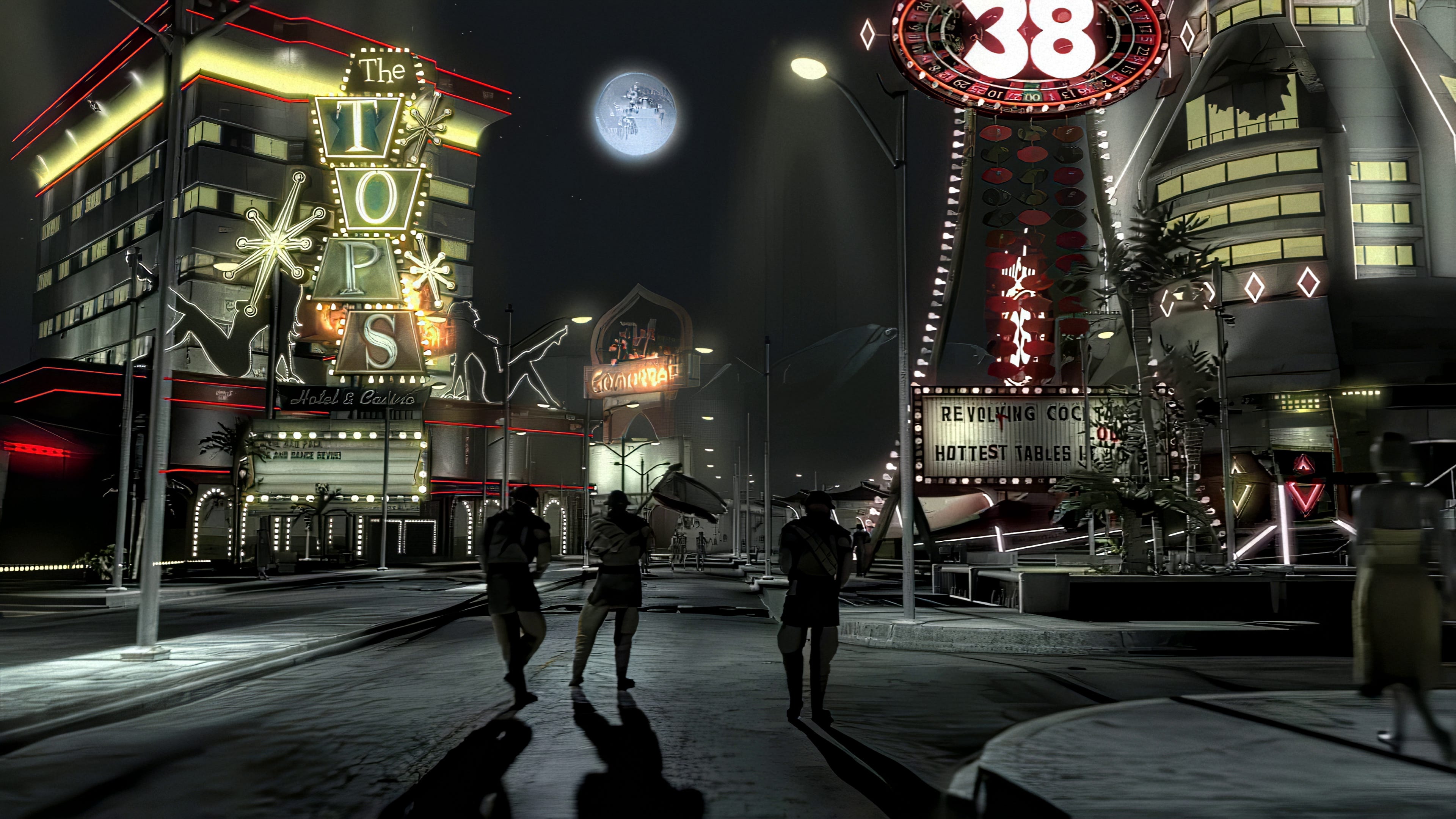
Fallout: New Vegas, Obsidian Entertainment, 2010
Fallout: New Vegas—next to Paradox grand strategy games—is really the only game I can think of that’s worth using to demonstrate concepts of security.
The core of New Vegas is built around the player choosing a faction to back based in large part on assessing three ideas: the capacity to enforce order, the legitimacy of political authority, and the broader question of whether a state meaningfully improves the lives of those under it.
First, for anyone unfamiliar1, let me give a short summary of the three main factions in New Vegas.
There’s the New California Republic, New Vegas itself2, and Caesar’s Legion—all of which stake their claims to being a potential provider of legitimate security to the wasteland.
All three present a sliding scale for the player to choose between in determining who eventually becomes the primary actor in the Mojave:
The NCR is democratic, has rights, and presents a genuinely idealistic option for what future life could be—but is bureaucratically incompetent, suffers from endemic corruption, and their internal security is wracked by constant non-state violence due to overstretched security forces.
New Vegas is wealthy, technologically advanced, and largely laissez-faire in the lives of its citizens, but is an autocratic surveillance state3 that features a permanent underclass subject to violence and starvation as the cost of maintaining the Vegas Strip.
Caesar’s Legion is the most internally stable of the three—with flourishing trade, ruthless modernization4, and complete lack of internal non-state violence—but is ruled as a consciously totalitarian slave state that uses mass violence to ensure peace.
Which brings me to what New Vegas has to say about security.
Look at it this way.
What is the primary responsibility of the state if not to act as a guarantor of security?
The NCR is wholly incapable of providing any sense of security in the territories they control.
Their actual state capacity is significantly strained under the weight of their unwieldy bureaucracy and corruption, rendering them only semi-capable of responding to emergent crises. NCR troops primarily remain confined to their bases and are unable to intervene in local affairs.
Economic life in the Mojave their control resultantly stagnates under their inability to tamp down on chronic violence.
Life under the NCR in the Mojave is the functional equivalent of living with an unresponsive government in the midst of an intractable insurgency.
New Vegas sits in an uncomfortable middle position as a security provider.
While the Vegas Strip itself is relatively free from violence, the slums of Freeside outside of the Strip are riven with crime. It is a rigidly hierarchical society, and those without the benefit of status are left largely to their own devices.
While Freeside is far from the worst of the violence in NCR territory, life there is still nasty, short, and brutish.
Their priorities, and to a certain extent House’s, are more about making whatever wealth they can, with tranquility on the Strip mostly just a means toward that end.
The structure of New Vegas more closely resembles a medieval feudal kingdom extracting resources from a population than a modern state with reciprocal obligations to its citizens.
Caesar’s Legion occupies the position as the faction performing duties that could most closely be associated with the state as envisioned by Hobbes: preventing internal non-state violence.
Their draconian methods—at least within the world of the Mojave—are the only approach that happens to effectively combat the chronic instability of the Mojave.
Caesar is also possibly the only person in the entire game who articulates a coherent vision of state formation. In his mind, the Legion is the foundation upon which a more stable order can eventually be built.
Strictly in terms of their ability to control a monopoly on violence, Caesar’s Legion is the only actor that actually possesses the capacity and will to do so.
However, legitimacy of the state—the measure by which a state is judged to be effectively representing and acting upon the interests of the citizens in a political community—also matters when we talk about security.
Here, New Vegas presents an inverse of the aforementioned case.
The NCR, despite providing the worst physical security of any option available, also—albeit imperfectly—represents a vehicle for improving the lives of the denizens of the Mojave.
Despite their problems with corruption and painful bureaucratic procedures, the NCR does work towards improving education, water access, and food security for those in their territory.
Unlike the other factions, the NCR also provides a limited sort of social safety net by way of charitable outreach to Freeside.
They are also a state with an ideology. Representing a sort of continuation of the pre-war United States, the NCR is imbued with legitimacy through ideas.
They have a population that, although often cynical, does in fact want to see a world brought into being better than the one they live in.
Which means that, while imperfect, they are the only option in the wasteland where common people have any sort of ability to participate in governance or seek to redress complaints.
Which shouldn’t be undervalued in terms of the long term legitimacy and sustainability of a political community.
In terms of the NCR’s system, they are the only faction that can be said to even make a superficial attempt at grounding their legitimacy through a political compact that goes beyond narrow interests.
New Vegas here is a bit idiosyncratic in that House is functionally indifferent to governance.
His operative philosophy more closely resembles that of anti-democratic technologist who rejects mass politics.
House represents a form of detached autocratic paternalism wherein the acceleration of technological advances and continued economic growth are a politics unto themselves and the citizens of the Strip are mere necessities to realize this.
His commitment to their well-being extends only so far as they don’t interrupt his personal parochial interests, and his rule is defined by a depoliticization of New Vegas with prosperity as the driver of his legitimacy.
However, the families on the Strip who act as the physical emissaries of House—and by extension are closer to the actual governing body of New Vegas than House actually is—represent nothing more than oligarchic extractionism.
Freeside, for what it’s worth, has no real governance, but merely competing sub-state actors.
It is a system that obtains legitimacy through short-term interest.
The citizenry of New Vegas will tolerate the arrangement only insofar as it directly benefits them and doesn’t overly burden them—but it is the same form of legitimacy that is engendered by a protection racket.
Finally, you have Caesar’s Legion.
Yes, they do provide security in the narrowest of senses.
But this needs to be balanced against the obvious fact that they are a slave state that views women as nothing more than property, and the overwhelming internal state coercion necessary to maintain this social structure.
The insecurity of non-state violence is largely replaced with state violence directed against most of the population.
Caesar is relatively explicit about the fact that he views the members of the Legion as not being citizens with whom the state has obligations, but an undifferentiated mass whose lives are meaningless in pursuit of his project of state-building.
His envisioned post-Legion state is also left fairly ambiguous outside of some inaccurate hand-waving about Hegel.
It is—fundamentally—an entirely personalist regime that has no conception of what it is beyond what Caesar decrees at any given moment.
The legitimacy of the Legion extends only so far as Caesar’s life and the Legion’s ability to continue to effectively exercise organized violence.
All of this is to say that New Vegas presents a difficult security landscape to navigate.
The state most likely to have durable long-term legitimacy is also the most unstable, and the state with the greatest security is prone to arbitrary collapse.
Caesar’s Legion is just non-state violence replaced by mass state violence. New Vegas is a criminal syndicate wearing the skin of a state. The NCR is a state without a monopoly on violence.
So what do we really want when we say we want security?
Is it merely the immediate absence of disorder? Is it a narrow relationship built purely on self-interest? Is it built long term through the relationship between citizens and the state?
Or is it just a question that was rigged from the start?
That being said. If you haven’t played New Vegas, why are you reading this? What could you possibly get from this?
I’m using “New Vegas” as being synonymous with House. If you go with Yes Man you’re a coward. Learn to pick a side.
Yes I know I just said New Vegas was laissez faire in it’s approach to domestic life. House innovated in the field of monitoring everyone but also doing absolutely nothing with that information.
Yes I know they don’t use technology. I’m using this in the sense of State creation.
I have always felt the NCR ending is only earned if you've done the work. If the Courier succeeds, local culture flourishes. Old warriors feel comfortable hanging up their spurs. Local settlements capable of securing themselves remain stoutly independent, or thrive from increased trade. The Brotherhood provides security services. The Fiends scatter. Local medical services expand. Trade routes from the NCR eastward stabilize. The Khans help resettle the Northwest. Local super mutants find peace (imagine that in Bethesdaworld!) Slavery is suppressed. Peaceful technology progresses. The downside is taxes go up. What a tragedy!
If you don't do all that, there's no correct ending. But if you do all that, the NCR provides the glue of legitimacy & ideology to stabilize it. It's the ending where I feel comfortable walking off into the sunset.
Realists always pick Legion, which is another reason why Realism is baby’s first IR theory.