
Generating Effects
How To Consider Strike Options

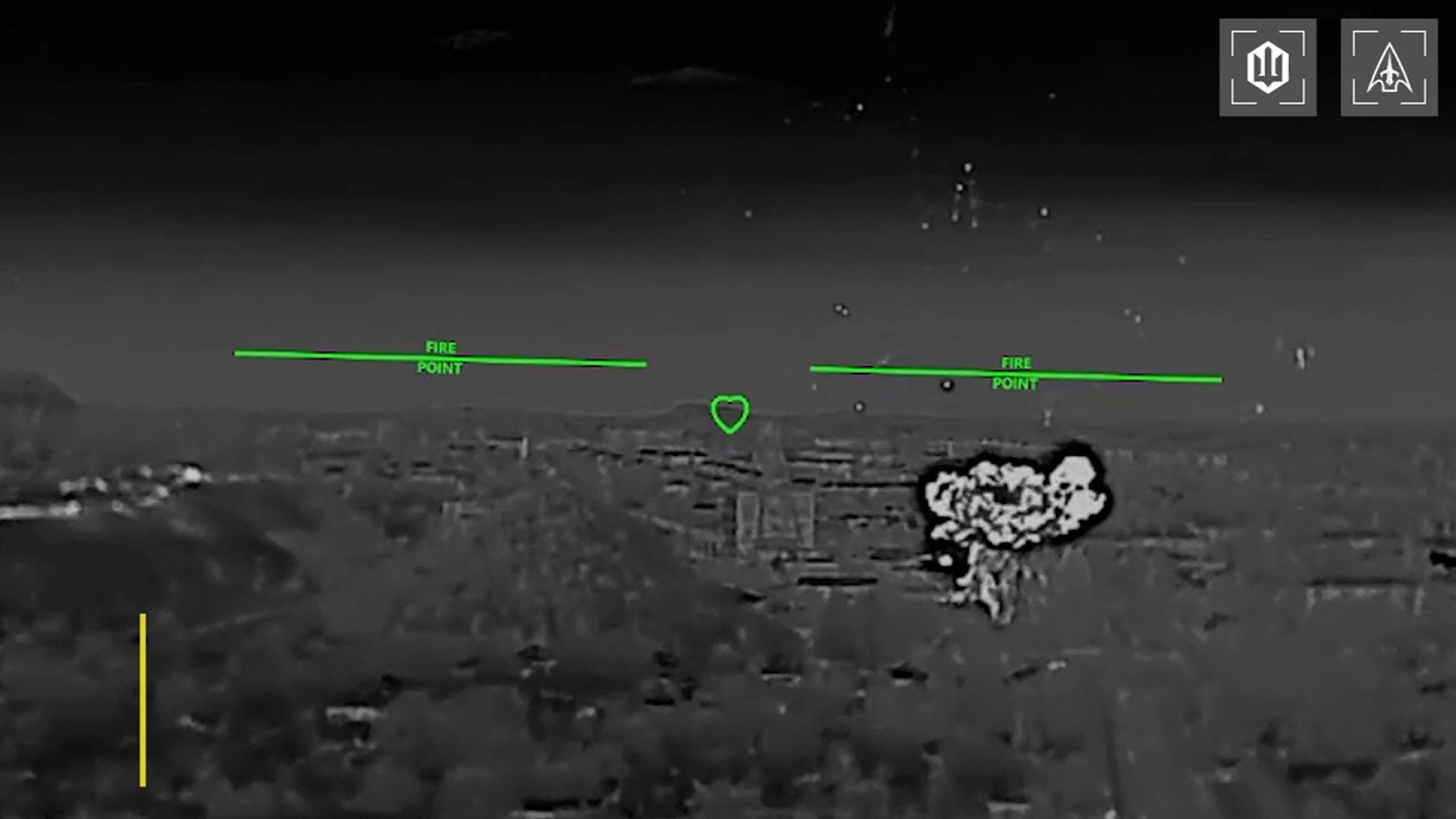
Frame from a Ukrainian FP-2 strike UAV involved in Ukraine’s ongoing middle-strike campaign
The drone argument has been one of the longest-running—and most exhausting—debates in military circles over the past four years.1
My contention here is that we’re having this conversation on the wrong grounds.
We have overly focused on the sort of techno-hype that is often associated with unrealistic Silicon Valley marketing—think AI-controlled military operations and drone swarms—than on looking at what we should actually be considering when integrating drones into military operations: effects.
To start with, I think “drone” and “UAV” tend to both be poor terms of art for even understanding what we’re talking about.2
The only thing that a commercial off-the-shelf FPV drone used at the tactical level to target singular personnel and long-range strike UAVs that target fixed sites like refineries have in common is that they do not have pilots.
Yes, they are both technically “UAVs,” but the effects they generate—and therefore the function they perform—are radically different.
A small FPV drone serves the same fundamental function as a battalion-to-company-level fires asset does. When you’re talking about systems in this class, what you’re really saying is that you need a fires capability for immediate tactical threats you encounter on the line of contact.
They can be guided either by radio or by fibre-optic cables, giving them a precision-strike capability that isn’t exactly the same as mortars or artillery3, but comes with drawbacks like susceptibility to electronic warfare, C-UAS capabilities, and weather that can completely ground operations.
Contrast this with the “middle-strike” drones that Ukraine has been fielding this year. These are a class of strike assets that are capable of ranging something like ~250 km while retaining capabilities for what is referred to as a “dynamic” strike4.
This is more akin to a poor man’s airstrike.
Given the limitations of these platforms, they’re unable to support heavier warheads associated with stand-in strikes conducted by manned platforms, and are thus much less capable of generating the same level of damage that a traditional bomb would. They can reliably destroy a truck, but hardened shelters are likely well outside their scope.
The next class would be long-range strike drones. Think a Shahed or an FP-1 drone.
They’re a substitute for cruise-missile capabilities and are primarily intended for fixed sites in an adversary’s rear. Factories, refineries, bridges.
They’re cheap, but like middle-strike drones, they lack the warheads associated with traditional cruise missiles and are limited in what they can achieve.
You also have the C-UAS class of drones, like Ukraine’s Sting interceptor drone or Raytheon’s Coyote.
You might be seeing a theme here, but these fill the role of being a cheaper and less capable air defense asset. They tend to be slower and are designed for point defense of assets, and can reliably intercept adversary drones—but lack high-end capabilities to intercept cruise and ballistic missiles.
I can keep going here and point out things like loitering munitions or the thousand different variations of ISR UAVs5 as well, but I think I’ve broadly made the point.
Drones are not a new class of military capability; they’re cheaper versions of systems we already have—and their value depends entirely on the kind of war we expect to fight and what effects we need to generate.
I don’t mean this to say that none of this matters.
I’m just saying that we need to stop talking about this as the next great revolution in military affairs and look at it for what it is. Systems that create battlefield effects. No different in function than what came before.
Which gets to the question of what we should be thinking about when we consider future procurements.6
The answer is that it depends.
It depends on what effects you want. It depends on the resources you have on hand. It depends on where you plan on fighting. It depends on how you plan on fighting.7
Do we want to generate strike packages of smaller quantities of highly capable strike assets? Or do we want to saturate an adversary with cheaper long-range strike UAVs?
Can we attain air superiority, or do we need attritable systems to fill in for this role?
Will we have fluid maneuver war, or will we need mass proliferation of tactical FPV drones to substitute for more expensive company fires?
Can we expect ABO and overflight from our allies, or will we be fighting at a distance?
Are we fighting in the Taiwan Strait, the Suwałki Gap, or the Sahel?8
These choices all come with resource trade-offs in terms of what we spend our defense budgets on.
Producing ten thousand long-range UAVs would be cheap in absolute terms, but doing that would mean less money going towards standing up more JASSM production lines.
We can have more Coyotes, but can we stand having fewer PAC-3s?
We can buy middle-strike UAVs to mitigate risk when interdicting logistics at the operational depth, but what existing units do we end up cannibalizing for this?
If we create the supply lines that allow us to mass-produce FPV UAVs, can we live with our 155mm factories atrophying?
If we invest in cheaper options but find out we do actually need the higher-end capabilities, would we be able to surge production in the event of a conflict? Do we pass up on the ability to create a competitive advantage in scaling cheaper massed fires?
Do we want to hedge and attempt to build a force with both capabilities and split our resources between all options?
Whether something is or is not suited to a task is really only a question of resource allocation and force design for the sort of fight we expect to be in.
They’re just systems. A platform is not good or bad.9 It’s just a question of what sort of war we think we’re going to end up fighting. It’s conditional.
There’s nothing special about any military platform.
I am not even going to attempt to list every single drone currently in existence here. If you’re looking for that, you can stop reading now.
I realize I say this, but then go on to just say drone and UAV throughout this; I just don’t know a better word to use. I’m unfortunately trapped like Wittgenstein within the limits of human language.
I say not exactly the same, since given the emergence of widespread ISR capabilities and sophisticated fire control, you can functionally provide a similar capability to quickly see and shoot anything in range of mortars and artillery as well.
A dynamic strike is a strike that isn’t strictly against a pre-planned fixed target. It’s a relatively broad term, but it really just means you retain the ability to adjust the strike until the moment of impact.
I think the rise of cheap mass ISR capabilities is actually new, but that’s sort of a separate issue from strike capabilities.
I unfortunately have to hand it to the Marine Corps and FD2030 for this one.
It’s also worthwhile that nobody ever fights the war they plan for. I suspect at some level most of these debates will be rendered moot if or when we ever get into a serious conventional fight that lasts for an extended period. Forces adapt, and platforms change too rapidly in contact for any of this to ever really have much permanence.
I could also go on here endlessly. I think you get the point. There are a lot of variables to consider when you talk about war.
I don’t mean this in the sense of shoddy construction. There can be poorly made systems. You know what I mean.
I have often wondered whether one of the drivers of Ukraine’s mass adoption of tactical level drone tech is driven by the fact that they lack the industrial capability to produce 155/152 in a way that would be traditionally needed for this conflict, while drones can be produced quickly without the factories required for artillery.
I’ve also wondered which system they would prioritize, if they had the choice.
Agreed