
American Melos

The Strong Reaping What They Must
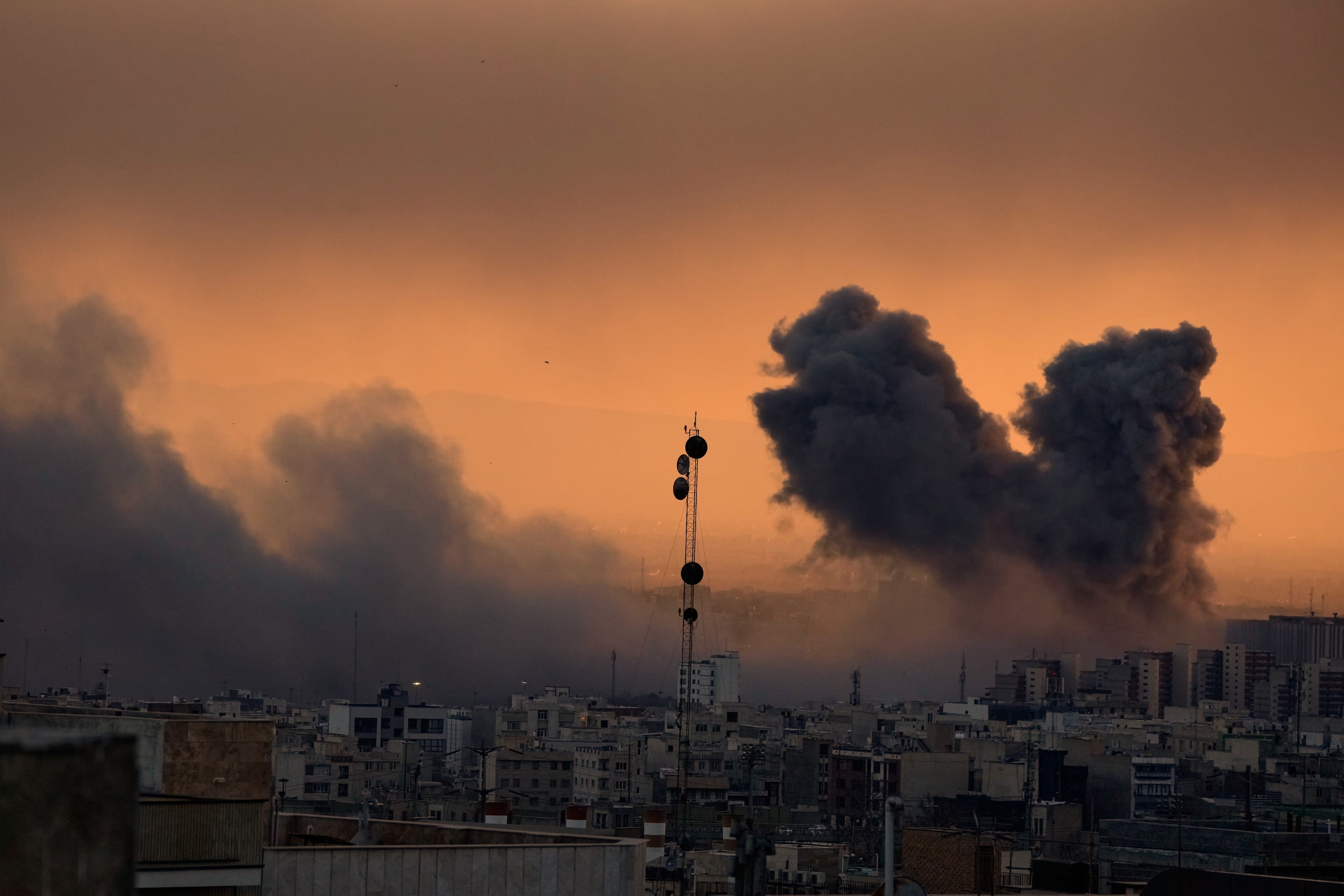
U.S.-Israeli military strike in Tehran, March 3, 2026, AP/Vahid Salemi
The Melian Dialogue is one of the most quoted—and most misunderstood—passages in Western literature.
It is often taught in isolation by international relations programs as a sort of ur-text of realism, serving as something like a practical explanation of how power truly operates in the world.
Administration officials like Stephen Miller have even taken to positively paraphrasing the dialogue as a defense of American actions since the beginning of Trump’s second term in power.
It is, however, only a lesson you can draw by ignoring the rest of what Thucydides wrote.
The Melian dialogue is, properly understood, a tragic construction meant to demonstrate the imperial hubris that had swept over Athens and led to her downfall.
To put the dialogue in its proper place, you have to be cognizant that we’re introduced to an Athens at the beginning of the Peloponnesian War that is extolled as the School of Greece by Pericles.
They are, despite their flaws, depicted as a shining city upon a hill—governed by reason, laws, and democracy. They control the largest alliance in Greece: the Delian League. Their vast trading network brings Athens greater wealth and cultural cachet than anywhere else in Hellas.
In other words, Athens was the undisputed Great Power of the Greek world at the outbreak of the conflict.
However, in the aftermath of the slaughter and enslavement of the population of Melos, Athens embarks on the disastrous campaign in Sicily which squanders such vast resources that the Athenian military never truly recovers.
The Athenian alliance system—by that point nothing more than an imperial system of control—also fragments under increasingly draconian Athenian measures.
While Thucydides dies before the completion of his history, we know thanks to Xenophon that Athens is left destitute and abandoned by her allies when she is finally conquered by Sparta.
The point that Thucydides was driving at was not merely that great powers could dominate the weak, but that unconstrained domination corrodes the strategic foundations of power itself.
In our contemporary moment, the United States—of course—possesses more military hard power than Iran.
We are, at least at the tactical level, able to inflict violence upon Iran at our leisure. Like Athens, there are largely no near-term constraints on our ability to continue to flex our capacity for violence internationally.
If we decide that our next target for military action is Cuba: there would be little meaningful opposition. We’re strong and we can inflict violence on the weak.
That is not to say, however, that these actions are not having a deleterious cumulative effect.
Like Athens, our once erstwhile allies now increasingly diverge from our positions. It has grown difficult to recruit our friends for our causes.
We have, similarly, squandered precious resources like THAAD interceptors, Tomahawks, and JASSMs that will take years to replenish and are critical in the event of a peer conflict.
Funds that could have been invested in strengthening our capabilities will instead have to be diverted to covering the costs of overseas combat operations.
Moreover, our priorities have grown so fickle under the Trump administration that we have pursued conflicts of marginal interest like Venezuela alongside senseless disputes over Greenland and Canada at the expense of abandoning Ukraine, pausing arms sales to Taiwan, and failing to deliver arms to Europe.
The supposed great advantage of strong arming our friends with tariffs has produced little more than resentment and a smattering of frameworks for future potential deals.
For all of these exertions, we have managed to achieve remarkably little in the way of tangible gains.
The Venezuela operation succeeded in merely replacing Maduro with his Vice President Delcy Rodriguez.
If the reporting on the prospective MOU to end the conflict with Iran is accurate, we will have expended vast resources in what would at best be a worse version of the JCPOA.
Like Athens, we are squandering the resources at our disposal on poorly considered foreign excursions at the behest of leaders increasingly guided by vanity, impulse, and the pursuit of their legacies.
Fortunately, and unlike Athens, however, we still sit among a vast array of institutional allies as the cultural and economic center of the world.
The damage, while real, does not imply that we too must choose to plunge ourselves into terminal decline like the Athenians once did.
It will, however, almost certainly leave the United States confronting a far more hostile and unstable world long after Trump himself has left office.
In one of my classes at the prestigious Arizona State University, more commonly known as the Harvard of the west. We debated whether or not the conquest and slaughter of Melos was right or wrong. Of course it is morally wrong, killing and war largely is.
I thought it was an entirely pointless exercise. Who cares whether or not Athens was right to do something or had the right.
The point was the Athenian empire was dying and they were lashing out more violently in an attempt to control it and be perceived as strong ie the failed Sicilian expedition.
Moreover understanding thucydides largely inserted himself into most dialogues as he wasn’t present. And he certainly wasn’t present for Melos, that dialogue I believe is likely the most fabricated dialogue in his history because the point of it was like you said to highlight the declining morality and the last agonal breaths of a dying empire.
Follow Me
RLTW
Toujour Pret
Be all you can be
IR usually fails to point out the long Greek tradition of irony in their literature. Just as Oedipus’s lineage was not a surprise to the audience of Sophocles, the fall of Athens wasn’t a surprise to Thucydides’s readers. The inclusion is clearly intended to highlight the self-defeated and short-sighted immorality of Athens after the death of Pericles.
This also feeds into my long-held belief that the greatest trick the Realists ever pulled was naming their theory Realism, since it tends to ignore many of the most powerful factors of policy in the real world.